

Introductory Rites
Entrance Rite (Stand)
The assembly stands. The entrance song is sung while the priest, ministers (e.g., lectors, altar servers), and the wedding party take their places in the sanctuary (near the altar). The Order for Celebrating Matrimony offers two forms for this.
In the First Form (#45-47) the priest and servers in vestments proper to the liturgy greet the bridal party at the door of the Church then all enter in procession as is customary for a Mass (the ministers go first, followed by the priest, then the bride and bridegroom, possibly proceeded by their parents and the two witnesses).
In the Second Form (#48-50) the priest and servers go to the place in the sanctuary prepared for the couple or to his chair, ready to greet the couple when they arrive at their place. In both forms, the priest leads the assembly in the sign of the cross after the entrance song is finished.
Greeting
The priest greets the assembly, and the people respond.
Opening Prayer
The priest invites the assembly to pray, then offers one of several possible prayers for the bride and groom. At the conclusion of the prayer, the assembly is seated for the Liturgy of the Word.

Liturgy of the Word
First Reading (Sit)
The first reading (from the Old Testament) is proclaimed by the lector. At the conclusion of the reading, the lector says, “The Word of the Lord,” and the assembly responds, “Thanks be to God.”
Responsorial Psalm
The cantor or choir sings a psalm, and the assembly sings the response.
Second Reading
The second reading (from a book of the New Testament other than the Gospel) is proclaimed by the lector. At the conclusion of the reading, the lector says, “The Word of the Lord,” and the assembly responds, “Thanks be to God.”
Gospel Acclamation (Stand)
The assembly stands. A cantor leads the assembly in singing the Gospel Acclamation, usually the Alleluia (except during Lent, when another acclamation is used).
Gospel
The priest (or deacon) proclaims the Gospel. At the conclusion, he says, “The Gospel of the Lord,” and the assembly responds, “Praise to you, Lord Jesus Christ.” The assembly sits.
Homily (Sit)
The priest (or deacon) offers a homily drawn from the Scripture readings. According to The Order of Celebrating Matrimony, the presider “uses the sacred text to expound the mystery of Christian Marriage, the dignity of conjugal love, the grace of the Sacrament and the responsibilities of married people, keeping in mind, however, the circumstances of this particular marriage” (#91).
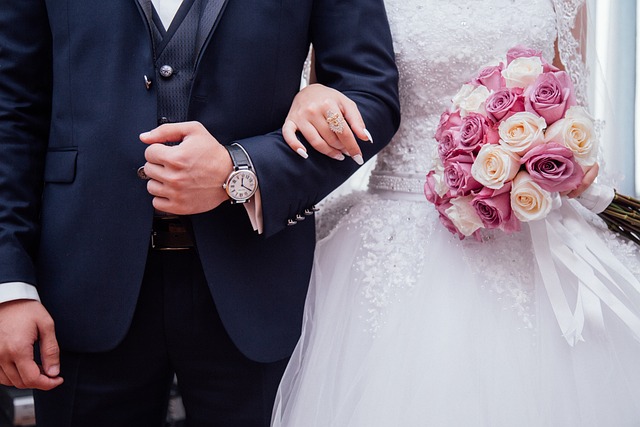
The Celebration of Matrimony
Address and Statement of Intentions (Stand)
All stand, including the bride and groom and witnesses. The priest asks the couple questions to state their intentions about their freedom of choice, fidelity to each other, and the acceptance and upbringing of children (unless the couple are beyond the child-bearing years). The bride and groom respond to each question separately “I have” or “I am.”
Exchange of Consent
The presider invites the couple to declare their consent to be married, which they do by stating their marriage vows. The Order of Celebrating Matrimony offers several different options for the vows The presider affirms the reception of the consent then leads the assembly in an acclamation which may be sung.
For more information on the vows, see:
Blessing and Giving of Rings
The presider blesses the wedding rings through prayer and the sprinkling of holy water. The husband places his wife’s ring on her finger, and the wife places her husband’s ring on his finger. The Order of Celebrating Matrimony provides options for the blessing of the rings as well as the exchange of arras (coins) according to local custom. While not specified in the ritual text, local custom may include the exchange of a kiss.
The Universal Prayer
The Universal Prayer, sometimes referred to as the Prayer of the Faithful or General Intercessions, is read by a lector, cantor, or another designated person. The reader usually offers each intercession (“For …, we pray to the Lord.”) and the assembly responds with an appropriate response, such as, “Lord, hear our prayer.” If Holy Communion will be distributed, the Lord’s Prayer is offered after the Nuptual Blessing.

The Lord’s Prayer
The assembly prays or sings together the Lord’s Prayer (the Our Father).
Our Father, Who art in Heaven,
Hallowed be Thy Name.
Thy Kingdom come,
Thy Will be done,
On earth, as it is in Heaven.
Give us this day our daily bread,
And forgive us our trespasses,
As we forgive those who trespass against us,
And lead us not into temptation,
But deliver us from evil.
Amen.

Nuptial Blessing
The couple kneels, the presider faces them and prays over them. The Order of Celebrating Matrimony provides options for the nuptial blessing, including beginning with the blessing and placing of the lazo (veil) if customary. If included in the ceremony, the distribution of Holy Communion immediately follows the Nuptual Blessing. Remember, only Catholics may receive Holy Communion during your celebration. If Holy Communion will not be distributed the presider concludes by blessing all gathered.
Conclusion of the Celebration
Blessing (Stand)
The presider prays a solemn blessing over the married couple and the whole assembly. All participate in the blessing by repeatedly responding, “Amen.” This blessing may be sung. The ritual text indicates the witnesses may sign the marriage license in front of the assembly, though never with the license on the altar (The Order for Celebrating Matrimony # 117).
Dismissal
While not specified in the ritual text, the presider commonly dismiss the assembly with an exchange like “Go in peace to glorify the Lord with your life” to which all gathered respond “Thanks be to God.”
Recessional
A recessional, or closing procession, is a natural way to conclude a Catholic wedding ceremony. Though it is not specified in The Order of Celebrating Matrimony, the couple, the bridal party, the ministers, and the presider process out of the church, usually accompanied by a festive song or instrumental music. Music suggestions for the wedding procession offer suitable options. Depending on local custom, the presider may invite the couple to exchange a kiss before leaving the sanctuary.

