
The following religious dictionary is a comprehensive guide that provides definitions and explanations of the Bible’s key terms, concepts, and figures. It is a valuable resource for readers seeking a deeper understanding of the Scriptures and the historical and cultural context in which they were written. From important theological terms to the names of prominent biblical figures, a biblical glossary helps readers navigate the rich and complex language of the Bible.
A
Aaron
A high priest and the younger brother of Moses and Miriam.
Abba
An Aramaic word for father. Jesus addressed God this way, conveying the intimate relationship between Christians and God.
Abbess
An ecclesiastical title for the head of a nunnery for women who chose to be nuns.
Abbey
A type of monastery used by members of a religious order under the governance of an abbot or abbess.
Abbot
An ecclesiastical title given to the head of a monastery for men who choose to be monks.
Abel
He is the younger brother of Cain and the second son of Adam and Eve in the first Book of Genesis in the Old Testament.
Abraham
The first of the Old Testament patriarchs and the father of Isaac.
Abrahamic
The religions, including Christianity, Islam, and Judaism, recognise Abraham as part of their religion. For example, Catholicism is the original Church of Christianity, thus an Abrahamic religion.
Acts
New Testament Book. Acts of the Apostles narrating the beginnings of the Christian church.
Adam
The first human whom God created in the Garden of Eden.
Advent
The preparation period for the celebration of Jesus’s birth.
All Saints’ Day
A holiday on the 1st of November commemorating all the saints of the church, both known and unknown, who have attained heaven.
Alb
A white vestment that reaches to the feet, worn by clergy.
Allegory
Form of literature in which a story points to a hidden or symbolic parallel meaning.
Alms Giving
Donating your time, money, services, or resources to others during Lent.
Alpha
The Greek alphabet’s first letter symbolises a journey’s beginning, starting point and comprehensiveness of God.
Altar
A table in a Christian church where the bread and wine are consecrated in communion services.
Amen
Derived from the Hebrew āmēn, which means “certainty,” “truth,” and “verily.”
Amos
Old Testament Book.
Andrew
One of the Twelve Apostles of Jesus Christ, the older brother of Simon-Peter, was a fisherman by trade.
Angel
Good supernatural spirits from Heaven who seek to help humans and worship God.
Anno Domini (AD)
Latin for “In the year of the Lord” indicates the year following the birth of Jesus Christ, commonly used for dating historical events in religious and secular contexts.
Annunciation
Refers to the biblical event in which the Angel Gabriel announces to the Virgin Mary that she will conceive the Son of God, Jesus Christ.
Anoint
Consecrated or made sacred; dedicated to God, often in a ceremony that includes dabbing or sprinkling with holy oil.
Apostle
A messenger or ambassador who is sent out to spread the teachings of Jesus Christ.
Apocrypha
Biblical or related writings not forming part of the accepted canon of scripture, some of which might be of doubtful authorship or authenticity.
Aramaic
Aramaic is the ancient language of the Semitic family group, which includes the Assyrians, Babylonians, Chaldeans, Arameans, Hebrews, and Arabs.
Archbishop
A bishop who oversees an archdiocese, which is typically a larger or more significant diocese, and may have additional responsibilities, such as coordinating and supporting the activities of neighbouring dioceses within a province.
Archangel
A specific rank of angels, entrusted with particular tasks. For example, the archangel Gabriel told Mary that she would have a son and name him Jesus.
Ark of The Covenant
A large golden chest that carries the two stone tablets of the Ten Commandments given to Moses by God.
Aspersorium and Aspergill
An aspersorium is a portable vessel that holds holy water. The priest dips an aspergill (or aspergillum) into the water and uses it as a sprinkler.
Ascension
The ascent of Jesus Christ into Heaven on the 40th day after his Resurrection.
Ash Wednesday
The first day of Lent with the placing of ashes on the foreheads of Christians.
Avarice
Also known as greed or covetousness. One of the seven capital sins. Inordinate desire for wealth or possessions or another’s possessions.
B
Babel (Tower of Babel)
A tower was built by Noah’s descendants, who intended it to reach Heaven. God foiled their act of hubris by confusing their language, which is a story that explains where languages and cultures come from.
Balthasar
One of the three wise men, also known as kings or magi, came from the east bearing gifts for the infant Jesus. He presented Jesus with the gift of myrrh.
Baptism
A Christian sacrament marked by ritual use of water and admitting the recipient to the Christian community.
Baptistery
The structure that holds the font which contains baptismal water where baptisms occur.
Barabbas
A prisoner chosen by the crowd over Jesus Christ to be released by Pontius Pilate.
Bartholomew (Nathanael) – Apostle
One of the Twelve Apostles of Jesus Christ. Also known as Nathanael.
Baruch
Old Testament Book.
Basilica
An early Christian church designed like a Roman basilica. These styles of buildings are known to have a large oblong hall with double colonnades and a semicircular apse.
Beatification
A recognition accorded by the Catholic Church of a deceased person’s entrance into Heaven and capacity to intercede on behalf of individuals who pray in their name.
Before Christ (BC)
Describes the year or century before the birth of Jesus Christ. Commonly used to date historical events in religious and secular contexts.
Behemoth
A large, powerful, grass-eating animal whose “bones are tubes of bronze, its limbs like bars of iron.” Job 40:15-24. One of God’s creations in the Old Testament.
Belt of Truth
One of seven pieces of God’s armour. Represents knowing the content of truth as revealed in Scripture.
Beelzebub
Another name for Satan the prince of the devils. It means “lord of the flies” in Hebrew.
Bethesda
The Bethesda Pool, where Jesus healed the paralytic man. Believed to have been a ritual bath.
Bethlehem
Birthplace of Jesus Christ. The site of the Nativity.
Bible
The Christian scriptures consist of the Old and New Testaments. The Old Testament is the Jewish Bible. Christians follow the New Testament as they are under a new covenant with new rules. There are also new and different requirements for salvation.
Biretta
A square cap with three or four ridges on its upper surface, sometimes surmounted by a tuft, worn by clergy in the church.
Bishop
A high-ranking clergy member in the Catholic Church who oversees a diocese, has the authority to ordain priests and deacons, and is responsible for teaching, governing, and sanctifying the faithful in their jurisdiction.
Bishop’s Staff (Crosier)
A staff with a hooked end similar to a shepherd’s crook or with a cross at the end, carried by an abbot, bishop, or archbishop as a symbol of office.
Bishop
The title of an ecclesiastical dignitary who possesses the fullness of the priesthood to rule a diocese as its chief pastor, in due submission to the pope’s primacy.
Blasphemy
To a insult, show contempt, disrespect or lack of reverence to God.
Bless
To be granted special favour by God with resulting joy and prosperity.
Blessed Mother / Blessed Virgin
A title for Mary, mother of Jesus and wife of Joseph.
Breastplate of Righteousness
One of seven pieces of the armour of God. It is specially designed by God to protect our heart and soul from evil and deception.
Brothers (Religious Vocation)
Brothers are men who take religious vows of poverty, chastity, and obedience, belong to a specific religious community, and dedicate their lives to prayer, service, and various ministries such as education, healthcare, or social work. They are similar to but not the same as Monks.
C
Caesar
The Roman emperors assumed the title ” Caesar ” after Julius Caesar. In the New Testament, various emperors were referred to by this title as sovereigns of Judaea without their distinctive proper names. The Bible mentions Augustus, Tiberius, and Claudius by name and in the Christian Greek Scriptures, “Caesar” is used to represent civil authority or the State.
Cain
He is the elder brother of Abel and the firstborn son of Adam and Eve in the first Book of Genesis in the Old Testament.
Calvary (Golgotha)
The hill near Jerusalem on which Jesus was crucified. Calvary (Latin for “Skull”) is also known as Golgotha (Aramaic for “Place of the Skull”).
Cana
A village or town near Capernaum, memorable as the scene of Christ’s first miracle.
Candace
Ethiopian Queen. Mentioned in the Bible when the apostle Philip meets her in the book of Acts.
Canon
The body of rules and scriptures is regarded as having authoritative power within a particular faith.
Canonisation
A deceased individual who has been officially recognised as a saint by the Roman Catholic Church.
Cantor
A person who sings solo verses or passages to which the choir or congregation respond.
Capernaum
The chosen city of Jesus to live in after He was driven out of his hometown of Nazareth.
Cardinal
A senior church official, appointed by the Pope, who serves as an advisor to the Pope, holds leadership roles in the Church, and is eligible to elect a new Pope in a conclave.
Cassock (Soutane)
An ankle-length garment with buttons down the front worn by priests.
Catholic
A member of the Roman Catholic Church. Something or someone associated with Catholicism.
Catholicism
The Abrahamic, monotheistic Christian religion that is the first original church from which all other branches of Christianity broke off in schism. Catholicism differs from other Christian churches in its practises, sacraments, view of the Virgin Mary, and acceptance of the papacy’s authority.
Catechism
A text that emphasises the methodical teaching of Bible truth based on fundamental knowledge that every believer should possess is presented in a way that facilitates comprehension and contains essential Christian principles.
Chapel
A small church or a holy place of sanctuary within a building.
Charity
One of the four theological virtues. The voluntary giving of help to those in need.
Chastity
Restraining impure passions and lustful impulses. Abstaining from extramarital, or all, sexual intercourse.
Chasuble
An ornate, sleeveless outermost vestment worn by Catholic priests when celebrating Mass.
Cherub
The cherub, also known in the plural form as Cherubim, is a type of angel. They are depicted as having two pairs of wings and four faces: that of a lion, an ox, a human, and an eagle. Their legs are straight, and the soles of their feet are like the hooves of a bull, gleaming like polished brass. They are believed to have protected the entrance of the Garden of Eden in Genesis.
Choir
An organised group of singers, especially those participating in church services or performing publicly. An individual member of a choir is called a Chorister.
Christ
A term that means anointed one. It is used as a title and a name given to Jesus. One who fulfilled the Old Testament prophecies, the chosen one who came to save us from sin and grant salvation.
Christening
A ceremony in which a child is given their Christian name in the presence of the church, family, and friends.
Christian
A person who follows or adheres to the religion of Christianity and the life and teachings of Jesus Christ.
Christianity
Abrahamic monotheistic religion, centred on the Bible, based on the teachings of Jesus Christ.
Christmas
Christmas is a festival that commemorates the birth of Jesus Christ and is celebrated on the 25th of December.
Christogram
A monogram (motif) or combination of letters representing the name of Jesus Christ, traditionally used as a religious symbol in the Christian Church. Common Christograms would include the Chi-Rho monogram, IHS and the Ichthys.
Chronicles
Old Testament Book.
Church
The spiritual church in the body of Christ. All those who have placed their faith in Jesus Christ for salvation. Also, a word to describe a physical place of worship where Christians congregate to celebrate mass.
Cincture (Belt)
A belt or cord tied around the waist, often symbolising chastity or the vows taken by the nun. It might also have a symbolic knot that represents these vows.
Clergy
The entire class of religious officials, from priests to pastors to bishops.
Clerical Collar (Roman Collar)
A white strip of material fastened around the neck as part of the priest’s clothing.
Colossians
New Testament Book.
Columbarium (Cinerarium)
A columbarium also called a cinerarium, is a structure for the reverential and usually public storage of funerary urns holding cremated remains of the dead.
Commandments
Prescriptions or directions from God concerning particular matters.
Communion (The Eucharist)
A sacrament in which consecrated bread and wine are consumed as memorials of Christ’s death or as symbols for the realisation of a spiritual union between Christ and communicant or as the body and blood of Christ.
Confession
A sacrament in which one discloses one’s sins to a priest.
Confirmation
A sacrament in which the Holy Spirit enters into the individual and purges them of the effects of the sin from their previous life (the guilt and blame of which were already washed away through baptism) and introduces them into the church as a new person in Christ.
Congregation
A group of people, particularly those who have come together for religious worship or who regularly attend a certain church.
Conscience
A moral sense of right and wrong
Consecration
The action of making or declaring something sacred.
Convent
A Christian community of nuns living together under monastic vows.
Cope (Mantum)
A long mantle or cloak, open at the front and fastened at the breast with a band or clasp. A mantum is similar to a cop but longer.
Conversion
The individual recognises their need for the one true Christian God and rejects all other alternatives. They have faith and seek repentance and salvation through Jesus Christ.
Corinthians
New Testament Book.
Covenant
A solemn agreement between God and humans, where God makes promises and sets conditions to be fulfilled.
Creation
The action or process of bringing something into existence. God created all the universe and all things in it out of nothing.
Creed
The Latin word for creed is “credo”, which means “I believe and trust”. The word is used to describe when one proclaims their faith.
Cremation
Burning a deceased person’s body to ashes, usually following a funeral service.
Crown of Thorns
A wreath made from thorny branches was placed on Jesus’ head as a crown to mock Him as a king and to inflict pain and humiliation during His crucifixion. The specific type of plant is not mentioned in the biblical texts. One probability is that it was made from the Egyptian thorn bush’s thorns or a similar species.
Crucifix (Cross)
Symbol of the Christian religion, recalling the Crucifixion of Jesus Christ and the redeeming benefits of his Passion and death.
Crucifixion
An ancient method of execution involved fastening a person to a cross in public until they died. The Romans used this punishment, and Pontius Pilate condemned Jesus to crucifixion. Crucifixion was viewed as an extremely brutal and humiliating way to die, intended to cause the victim immense suffering.
D
Dalmatic
A long, wide-sleeved tunic worn by members of the clergy.
Damascus
Capital of Syria. Jesus showed himself to Saul of Tarsus on the road of Damascus. Saul then became a of Jesus’ apostles, and his name was changed to Paul.
Daniel
Old Testament Book.
David
A young shepherd boy slays Goliath using a stone and sling.
Deacon
An ordained minister who assists bishops and priests in liturgical roles, preaching, performing baptisms, witnessing marriages, and serving the needs of the Church and community, but cannot consecrate the Eucharist or hear confessions.
Deity
A supernatural being is worshipped by people who believe it controls or exerts force over some aspect of the world. Christians believe in the one monotheistic deity called God.
Demons
Evil supernatural spirits from Hell who seek to harm humans. They are minions of Satan and revolt against God.
Despair
The sin by which a person is in a state of hopelessness. To give up all hope of salvation or of the means necessary to reach heaven. Choose to disbelieve God and His many promises.
Deuteronomy
A book in the Old Testament.
Devil
Also known as Satan and referred to in the Bible as “the Prince of this Earth”. The personification of evil and the ruler of Hell. He rebelled against God in an attempt to become equal to God himself.
Diocese
A geographical area or region administered by a bishop.
Disciple
Someone who follows was changed by or committed to Jesus and his teachings.
Doctrine
A set of beliefs, teachings and rules within the Christian faith.
Doctor of the Church
A title the Catholic Church gives to saints whose writings and teachings have significantly contributed to Church doctrine and theology.
Dominations
A celestial being or angel that governs the movement of stars, planets, and other heavenly bodies.
E
Easter
Marks the Resurrection of Jesus after his death by crucifixion.
Ecclesiastes
Old Testament Book.
Ecclesiastical
Relating to the Christian Church or its clergy.
Eden
Also known as the Garden of Eden, where Adam and Eve lived in the biblical account of the Creation, from which they were expelled for disobediently eating the fruit of the Tree of Knowledge. Eden is known as a paradise.
Egypt
During the time of Moses, Egypt was a powerful and advanced civilization in northeastern Africa. It was ruled by powerful pharaohs and was known for its impressive architecture, such as the pyramids, and its complex religious beliefs. Moses is a significant figure in the Old Testament as he is traditionally considered to have led the Israelites out of Egypt during the Exodus, over 1400 years before the birth of Jesus.
Elder
A person valued for wisdom holds a position of responsibility and authority in a Christian group.
Envy
Also known as jealousy. One of the seven capital sins. Resentment or sadness at another’s good fortune or excellence, with an often-insatiable desire to have it for oneself.
Ephesians
New Testament Book.
Epistle
Letter written on a scroll. The primary form of written communication in the ancient world, especially during New Testament times. Many New Testament books were originally written as letters to churches or individuals.
Esther
Old Testament Book.
Eternal
Everlasting, existing outside the realm of time.
Eucharist
A sacrament that commemorates the Last Supper, in which bread and wine are consecrated and consumed. Bread and wine turn into the body and blood of Christ through transubstantiation.
Eulogy
A short speech or written piece that praises someone who has recently died.
Eunice
Mother of Saint Timothy.
Evangelist
Someone who proclaims good news. A preacher of the gospel or a missionary.
Eve
The first woman created by God as a companion for Adam.
Evil
Anything that goes against God’s moral standards. Sin, rebellion against God, mistreatment of others, and spiritual forces of wickedness.
Exodus
Old Testament Book.
Exorcism
The expulsion or attempted expulsion of a supposed evil spirit from a person or place.
Exorcist
Someone who expels demons or evil spirits from a person or place.
Exsultet
Also known as the Easter Proclamation that is sung during the Easter Vigil.
Ezekiel
Old Testament Book.
Ezra
Old Testament Book.
F
Faith
One of the three theological virtues. The assurance of things hoped for, the conviction of things not seen.
Fallen Angel
An angel who rebelled against God and was cast out of heaven, Satan is an example of a fallen angel.
Fasting
The giving up of food or something else for some time for spiritual purposes. Fasting occurs for Christians during Lent.
Fellowship
Shared participation and commonality within the Christian community.
Font
A vessel used for baptism ceremonies.
Forbearance
Holding back or restraining the self from doing something that is considered normal to do. It is controlling oneself when provoked or offended.
Forgiveness
Letting of resentment and giving up any claim to be compensated for the hurt or loss we have suffered.
Fortitude
One of the four cardinal virtues. Spiritual resilience and steadfastness beyond physical courage.
Frankincense
Incense made from tree sap used for religious ceremonies.
Free Will
God granted human beings the power to make their own ethical decisions, good or evil, that will affect their soul’s destiny after death.
G
Gabriel
Saint Gabriel the Archangel. Appeared to Mary to tell her she was going to be the mother of Jesus.
Galatians
New Testament Book. It is a letter from Paul the Apostle to several Early Christian communities in Galatia.
Galilee
Jesus was born in Bethlehem and grew up in Nazareth. Both areas are in the Galilee region.
Garden of Eden
Earthly paradise inhabited by the first created man and woman.
Gaspar (Caspar)
One of the three wise men, also known as kings or magi, came from the east bearing gifts for the infant Jesus. He presented Jesus with the gift of frankincense.
Genesis
The first book of the Old Testament where it describes God’s creation of the universe and all life in it.
Gentile
Anyone who is not of Jewish descent.
Gethsemane
The garden outside Jerusalem is associated with the agony and arrest of Jesus.
Glory
It means praise, honour, renown, worship, praise, thanksgiving and showing glory to God.
Gluttony
One of the seven capital sins. Excessive eating and drinking. Drunkenness, which is caused by excessive consumption of intoxicating beverages, is considered a type of gluttony.
God
Supreme being. The eternal and infinite spirit. The creator and sovereign king of the universe. God the Father.
Godhead
Or godhood. Refers to the essence or substance of God in Christianity. God the Father, Son, and Holy Spirit.
Godparent
Someone who bears witness to a child’s baptism and later is willing to help in their catechesis and their lifelong spiritual formation.
Golden Rule
Do to others as you would have them do to you.
Matthew 7:12
Goliath
A giant Philistine warrior who is slayed by David using stone and sling.
Gomorrah
One of two cities destroyed by God for their wickedness.
Good Friday
Christian holy day that observes the crucifixion of Jesus and his death at Calvary. It is called Good Friday because Jesus’s death on the cross was the ultimate sacrifice for humanity’s sins and set up the events of Easter when he was resurrected.
Gospel
The story of Jesus Christ’s birth, death, and resurrection. Referred to as “The Good News”.
Gospel of Peace
One of seven pieces of the armour of God. Refers to the peace that comes from having a relationship with God, as well as the peace that comes from God. The gospel of peace is represented by the shoes of the armour of God.
Grace
Undeserved, freely given favour from God.
Greek (Hellenistic)
The influence of Hellenism had spread the Greek language across many regions, including Judaea. By the time of Jesus, Greek was widely used in trade, philosophy, and literature, making it the language of the New Testament. The term “Hellenistic” refers to Greek culture and the period between the death of Alexander the Great in 323 BC and the rise of the Roman Empire.
H
Habakkuk
Old Testament Book.
Habit
A nun’s habit is a distinctive set of religious clothing worn by women who have taken vows in certain Catholic religious orders.
Haggai
Old Testament Book.
Hail Holy Queen
A prayer asking Mary for her prayers on our behalf.
Hallelujah
Hebrew liturgical expression, usually rendered in English as “Praise the Lord.”
Heaven
Primarily understood as God’s dwelling place, a parallel realm where everything occurs according to God’s will. It is a place characterised by peace, love, community, and worship, where a heavenly court and other divine beings surround God.
Hebrew
Hebrew is the ancient language of the Semitic family group, which includes the Assyrians, Babylonians, Chaldeans, Arameans, Hebrews and Arabs.
Hebrews
New Testament Book. Also, a term used to describe ancient Israelites who were descendants of the patriarchs of the Hebrew Bible.
Helmet of Salvation
One of seven pieces of God’s armour. Represents the certainty of salvation and victory over evil though faith.
Hell
A definitive self-exclusion from communion with God and the blessed. Occurs because of the refusal to repent of mortal sin before one’s death since mortal sin deprives one of sanctifying grace.
Herod (Herod the Great and Herod Antipas)
King Herod, also known as Herod the Great, was the king of the Roman province of Judaea. He ordered the death of all children under age two in Bethlehem in an attempt to kill Jesus as an infant. Herod Antipas was the son of Herod the Great, who ruled Galilee, a district of Judaea, during Jesus’ ministry as an adult.
Holy
Related to a religion or a God. Very religious or pure.
Holiness
The state of being holy.
Holy Spirit
The third Person of the Holy Trinity – Father, Son, and Holy Spirit, and is Almighty God. Unites the believer with Christ and places him in the body of Christ, the church
Holy Week
Commemorates Jesus’ last days and crucifixion. Holy Week leads up to the celebration of Easter Sunday – the day Christians celebrate Jesus rising from the dead.
Hope
One of the three theological virtues. Firm assurance, trust or faith that God’s promises will come to pass.
Hosanna
A word from the Bible that means “please save us”. Used to express adoration, praise, or joy. “Hosanna in the highest.”
Hosea
Old Testament Book.
Host (Sacramental Bread)
Sacramental bread used during the Eucharist to symbolise the body of Christ. It is made from simple ingredients: wheat flour and water, without any additives or leavening agents.
Humility
One of the seven capital virtues. Recognition of our fallen nature and our need for God. Putting others before ourselves and serving one another humbly in love.
I
Idol
An image, statue, person, item or pagan deity that is regarded as equal to or greater than God. Forbidden in Christianity according to the 1st Commandment.
Idolatry
The worship of someone or something other than God as though it were God. Forbidden in Christianity according to the 1st Commandment.
Immaculate Conception
The Virgin Mary was free of original sin from the moment of her conception.
Incarnation
That God assumed a human nature and became a man in the form of Jesus Christ, the Son of God
Incense
A fragrant made from spices, aromatic gums and balsams that burn slowly. The rising smoke came to symbolise prayers rising to God. A thurible, a metal censer, is used to burn incense during Catholic religious services.
Isaiah
Old Testament Book.
Isaac
The firstborn son of Abraham and Sarah and the younger half-brother of Ishmael.
Ishmael
The first son of Abraham and Hagar and the older half-brother of Issac.
Israel
God named Jacob as Israel. This name change occurred after Jacob wrestled with an angel, symbolising his struggles and triumphs. The name “Israel” means “he who struggles with God” and signifies his important role as the patriarch of the Israelites.
Israelite
The descendants of Jacob, a Hebrew patriarch.
J
Jacob
The son of Isaac and Rebecca and the grandson of Abraham.
James Son of Zebedee – Apostle
New Testament Book. James was the older brother of John the Apostle, a fisherman by trade, and one of the Twelve Apostles of Jesus Christ.
James Son of Alpheus – Apostle
One of the Twelve Apostles of Jesus Christ. Not to be confused with James the Apostle, Son of Zebedee as they are two different people. Apostles Matthew and James are associated with Alphaeus; however, the Bible does not say they were brothers. This remains a topic of speculation.
Jehovah
Another name for God.
Jeremiah
Old Testament Book.
Jerusalem
Believers revere Jerusalem’s significance as the city where Jesus walked, was crucified and rose from the dead.
Jesus Christ
The religious leader of Christianity, Jesus Christ is the incarnation and Son of God, the Second Person of the Trinity, who came to the Earth to be humanity’s Saviour as the promised Messiah.
Joanna
She was healed by Jesus and is one of the women recorded in the Gospel of Luke as accompanying Jesus and the Twelve Apostles. She was a witness to Jesus’ resurrection.
Job
Old Testament Book.
Jochebed
Mother of Moses, Aaron and Miriam. She saved Moses as a newborn from being killed under the Egyptian Pharaoh’s orders. She put her baby in a basket and hid it in tall grass by the Nile River.
Joel
Old Testament Book.
John, John 1,2 and 3
Four New Testament Books ascribed to John the Apostle.
John – Apostle
He was the younger brother of James Son of Zebedee, a fisherman by trade, and one of the Twelve Apostles of Jesus.
John the Baptist
Prophet known in Christianity as the cousin and forerunner of Jesus, John preached about God’s Final Judgment and baptised repentant followers in preparation for it. He baptised Jesus in the river Jordan. Was martyred for criticising King Herod.
Jesuits
Jesuits, formally known as the Society of Jesus, are a religious order of priests and brothers founded by St. Ignatius of Loyola, dedicated to education, missionary work, and promoting social justice, while emphasizing spiritual growth through the Ignatian tradition.
Jezebel
The wife of Ahab, the king of ancient Israel, is considered a wicked and shameless woman.
Jonah
Old Testament Book.
Jordan River
River that flows north to south from the Sea of Galilee to the Dead Sea.
Joseph
Jesus’ earthly father and the Virgin Mary’s husband. St. Joseph is the patron of the universal church in Roman Catholicism.
Joshua
Old Testament Book.
Judaism
The ancient Hebrews developed and practised the Abrahamic monotheistic faith known as Judaism. This religion focuses on the Torah and the messages conveyed by the Hebrew prophets in the Old Testament. During his life, Jesus was born and raised within the Jewish faith.
Judas Iscariot – Apostle
Betrayed Jesus by disclosing Jesus’ whereabouts for 30 pieces of silver. Judas brought men to arrest Jesus and identified him with a kiss. Jesus was then arrested, tried, and executed. Not to be confused with Judas Thaddeus.
Jude/Judas Thaddeus/Lebbaeus – Apostle
One of the twelve Apostles of Jesus and the Patron Saint of Hope and impossible causes. Has different names used in various biblical accounts and texts to refer to the same apostle. Not to be confused with Judas Iscariot.
Judges
Old Testament Book.
Judaea
Judaea was a province in the Middle East that was under the rule of the Roman Empire from 6 to 132 AD. Jesus was born in Judaea during this time.
Judith
Old Testament Book.
Jude
New Testament Book.
Justice
One of the four cardinal virtues. The constant and firm will to give their due to God and neighbour.
K
Keys of Heaven (Saint Peter’s keys)
The keys of the office of Saint Peter, the first pope, are symbolically referred to as the keys of Heaven or the keys of the kingdom of Heaven. Peter is often depicted in artwork holding these keys.
Kindness
One of the seven capital virtues. Love, compassion, and a genuine concern for the well-being of others.
King David
The second ruler of the United Kingdom of ancient Israel and Judah. He founded the Judaean dynasty and united all the tribes of Israel under a single monarch.
Kingdom of God
The spiritual realm or universe over which God reigns as the eternal, sovereign king, or the fulfilment on Earth of God’s will.
Kings 1 and 2
Two Old Testament Books named 1 Kings and 2 Kings.
L
Laity
All members of religious organisations who are not members of the clergy are referred to as laity. This often includes non-ordained members of religious orders, such as lay brothers or nuns.
Lamentations
Old Testament Book.
Land of Milk and Honey
God promised Abraham a land “flowing with milk and honey,” a rich and fertile land.
Last Supper
The final meal that Jesus shared with his apostles before his crucifixion. A Passover feast where Jesus transformed the bread and wine into his body and blood, thereby instituting the Eucharist.
Latin
The language of ancient Rome and its empire, Latin, was widely used historically as a language of scholarship and administration. The Romans spoke Latin at the time of Jesus in Roman-occupied Judaea, and it is the official ecclesiastical language of the Catholic Church.
Lazarus
One of the miracles of Jesus mentioned in the Gospel of John is the restoration of life to Lazarus, four days after his death.
Leah
Wife of Jacob and mother of Levi.
Lectionary
A list or book of portions of the Bible appointed to be read at divine service.
Legion
Refers to the group of demons, particularly in the story of the Gerasene demoniac, an account in the New Testament where Jesus performs an exorcism.
Lent
A period of 40 days during which many Christians remember the events leading up to and including the death of Jesus Christ.
Leper
A term used for a person with leprosy. It is a contagious disease that affects the skin, mucous membranes, and nerves, causing discolouration and lumps on the skin. In severe cases, disfigurement and deformities. Leprosy was a common disease at the time of Jesus.
Levi
In the Old Testament, Levi is one of the twelve sons of Jacob and Leah and great-grandfather of Aaron, Moses and Miriam. In the New Testament the Gospels of Mark and Luke refer to the apostle Matthew as Levi, son of Alphaeus.
Leviathan
A sea serpent. One of God’s creations in the Old Testament.
Leviticus
Old Testament Book.
Liturgical Calander (Ecclesiastical Calendar)
It is made up of the liturgical day-season cycle that establishes the reading of scripture and the timing of feast days, including saints’ festivals.
Limbo of the Fathers
The temporary state of those who, despite the sins they may have committed, died in the friendship of God but could not enter heaven until redemption by Jesus Christ made it possible.
Liturgy
The customary public ritual of worship.
Lois
Grandmother of Saint Timothy.
Lord’s Prayer
Encourages Christians to cling to God’s will, seek forgiveness, help avoid temptation, and ask for protection against Satan.
Lucifer
The original name of Satan (the Devil), before he was cast out from heaven into hell because he rebelled against God, is Lucifer. Both names are used interchangeably.
Luke
New Testament Book written by St. Luke who also wrote the Acts of the Apostles. He was one of the Four Evangelists. Was said to be a doctor by trade.
Lust
One of the seven capital sins. The desire for anything sinful, such as illicit intercourse, intoxication, ill-gotten gain, revenge, or anything else that God forbids.
M
Maccabees
Old Testament Book.
Malachi
Old Testament Book.
Maniple
Used primarily within the Latin Rite of the Catholic Church, it is an embroidered band of fabric like silk that hangs from the left forearm, worn over the alb. It comes in different colours, depending on events in the liturgical calendar and special occasions.
Mark (John)
New Testament Book by Mark who was a cousin of Barnabas and became an evangelist. Mark is also referred to as John in the book of Acts in the Bible. Accompanied Paul and Barnabas on their missionary journeys.
Marriage
Also known as Matrimony, it is a God-ordained sacrament. A monogamous, freely chosen union (or covenant) between one man and one woman for life.
Martyr
In the Bible, a martyr is one who bears witness to the truth and suffers death in the cause of Christ.
Mary
Mary, the mother of Jesus and wife of Joseph, was free of original sin from the moment of her conception. She is referred to as the Blessed Virgin because she conceived Jesus through a virgin birth by the power of the Holy Spirit.
Mary of Bethany
The sister of Martha and her brother Lazarus, whom Jesus raised from the dead.
Mary Magdalene
A woman described in the four gospels accompanied Jesus and the apostles as one of His supporters. She observed His crucifixion and is reported to be among the first to encounter Him following His resurrection. Jesus had freed Mary Magdalene from demon possession.
Martha
The sister of Mary of Bethany and her brother Lazarus, whom Jesus raised from the dead.
Mass
A liturgical service is a form of public worship where Christians celebrate the sacrament of the Eucharist in a church.
Matthew (Levi, son of Alphaeus)
Jesus Christ’s tax collector apostle Matthew wrote the Gospel of Matthew in the New Testament. The Gospels of Mark and Luke refer to Matthew as Levi, son of Alphaeus. Apostles Matthew and James are associated with Alphaeus; however, the Bible does not say they were brothers. This remains a topic of speculation.
Matthias
Matthias was chosen to replace Judas Iscariot after he betrayed Jesus. The early disciples sought to find a suitable replacement to maintain the group’s number of twelve. Matthias was selected by casting lots (similar to throwing dice) highlighting the emphasis on God’s divine guidance in the decision.
Meditation
Pondering the words of Scripture with a receptive heart, trusting the Holy Spirit to work in you through those words.
Meek
A calm temper of mind not easily provoked. Enduring injury with patience and without resentment or resistance to the will of God.
Melchoir
One of the three wise men, also known as kings or magi, came from the east bearing gifts for the infant Jesus. He presented Jesus with the gift of gold.
Messiah
A leader. Regarded as a saviour of a group of people. Jesus Christ is considered the saviour who delivered humanity from original sin.
Micah
Old Testament Book.
Michael
Saint Michael the Archangel. Defender of faith, protector of souls, and a symbol of divine justice.
Miracles
It is an event that involves God’s direct and decisive action, transcending the ordinary laws of nature and defying common expectations of behaviour.
Moses
Brother of Miriam and Aaron. A Hebrew prophet who led the Israelites out of Egyptian slavery. God gave Moses the Ten Commandments at Mount Sinai. Moses is a significant figure in the Old Testament, as he is traditionally considered to have led the Israelites out of Egypt during the Exodus, over 1400 years before the birth of Jesus.
Middle East
The region located in western Asia and northeastern Africa includes the nations of the Arabian Peninsula, Egypt, Iran, Iraq, Israel, Jordan, Lebanon, Syria, and Turkey. Jesus originated from this region during the period of the Roman Empire.
Miraculous Medal
The Catholic Miraculous Medal is a devotional medal featuring an image of the Blessed Virgin Mary, given to St. Catherine Labouré in 1830, believed to offer spiritual graces and protection to those who wear it with faith.
Miriam
Older sister of Moses and Aaron.
Missal
A liturgical book used by the priest in the Roman Catholic Church to celebrate the Mass. It contains the prayers, hymns, and instructions needed for the celebration of the Eucharist.
Mitre
A tall headdress that tapers to a point at the top. Worn by senior officials in the Catholic Church.
Monastery
A house or residence occupied by a community of monks living in seclusion under religious vows.
Monastic
A religious way of life of Christian Monks and Nuns who live ascetic and typically cloistered lives dedicated to worship.
Monk
A man who is a member of a religious order and lives in a monastery. They are similar to but not the same as religious brothers.
Monotheism
The belief in a single god. This is different from polytheism, which is the belief in multiple gods. Christianity is a monotheistic religion.
Monstrance (Ostensorium / Ostensory)
A vessel used to display the consecrated Eucharistic host.
Myrrh
An anointing oil was given to Jesus by one of the wise men when he was born.
N
Naamah
Noah’s Wife.
Nahum
Old Testament Book.
Nativity
The birth of Jesus.
Nazareth
Nazareth was a village in Lower Galilee during the Roman period and was the childhood home of Jesus.
Nehemiah
Old Testament Book.
New Testament
The second part of the Christian Bible. It consists of 27 books and focuses on the life, teachings, death, and resurrection of Jesus Christ and the formation and teachings of the early Church. These books were initially written in Greek.
Niece Creed
A profession of faith during Catholic Mass after the homily or in response to the proclamation of God’s Word.
Nile River
Egyptian river Moses was hidden in as a newborn baby.
Noah
Old Testament patriarch who built the ark in which he, his family, and living creatures of every kind survived the Flood.
Numbers
Old Testament Book.
Nun
A woman who is a member of a religious order and lives in a nunnery/monastery. They are similar to but not the same as religious sisters.
Nunnery
The convent or religious house of a community of nuns.
O
Obadiah
Old Testament Book.
Old Testament
The first division of the Christian Bible consists of 46 books. This collection prepares the way for the New Testament and the arrival of Jesus Christ, who fulfils the prophecies and promises found within these texts. Most of the books were written in Hebrew, while some were written in Aramaic.
Omega
The last letter of the Greek alphabet symbolises the end of a journey and the comprehensiveness of God.
Original Sin
A term that defines the nature of humanity’s flawed nature or sinful condition because of Adam’s fall in the Garden of Eden.
Ordination
The act of the church in choosing, appointing, and setting apart certain individuals to perform specific functions on behalf of the church.
Our Father
Also known as the Lord’s Prayer. A central Christian prayer that Jesus taught to the laity.
P
Palm Sunday
Commemorates the entrance of Christ into Jerusalem, during which palm branches were placed in his path, before his arrest on Holy Thursday and his crucifixion on Good Friday. It thus marks the beginning of Holy Week, the final week of Lent.
Papacy
The position, power, and authority of the Pope, including the period that a particular person holds this position.
Papal Staff (Ferula)
The pope uses this in the Catholic Church. It is a rod with a knob on top, topped with a cross.
Papal Tiara (Triregnum)
A triple crown, also known as the Triregnum. Historically, Papal Coronations were practiced when new Popes were crowned with a papal tiara in a coronation ceremony, symbolising their authority and role within the Church. This practise and the use of the crown has ceased and have been replaced with Papal Inaugurations.
Papal Regalia and Insignia
The Vatican Coat of Arms consists of two crossed keys interlaced by the papal tiara. The keys symbolise the Keys of Heaven and were presented to St. Peter by Christ.
Passover
Passover is a significant holiday in Judaism that symbolises the Israelites’ liberation from bondage in Egypt through Moses. From a Catholic perspective, it is a precursor to the Eucharist and the Last Supper and is celebrated during Holy Week. During the Last Supper, a Passover feast, Jesus transformed the bread and wine into his body and blood, thereby instituting the Eucharist.
Paten
A small, shallow plate used during the celebration of the Eucharist. Holds the hosts that are consecrated and distributed to the congregation during Communion.
Patron Saint
A Christian saint who is believed to give special help to a particular place, activity, person, or type of object. For example, St. Patrick is the patron saint of Ireland.
Parable
It is a short and simple story that teaches a religious or moral lesson. A fable or allegorical relation or representation of something real in life or nature from which a moral is drawn for instruction.
Paschal Mystery
The central focus of Catholic faith and theology is the history of salvation, which encompasses the passion, death, resurrection, and glorification of Jesus Christ. This is crucial to the Christian faith because God’s saving plan was fulfilled through the redemptive death of Jesus.
Passion
To suffer, bear, endure. The short final period before the death of Jesus.
Pastor
A priest in charge of a Catholic parish or congregation. He is responsible for administering the sacraments, instructing the congregation in the church doctrine, and providing other services to the people of the parish.
Patience
One of the seven capital virtues. The ability to endure difficult circumstances without losing hope or giving in to anger.
Pellegrina (Mozzetta)
A short cape that drapes to the elbows. It is lined and trimmed in either amaranth red for bishops or scarlet red for cardinals, and its fabric can be either black or white. The pope’s pellegrina is all white. The mozzetta has buttons, while the pellegrina is open in the front and secured with a clasp.
Pentecost
The occasion of the descent of the Holy Spirit upon the Apostles and other followers of Jesus Christ.
Pew
A long bench seat or enclosed box. Used for seating a congregation or choir members in a church or sometimes a courtroom. A typical form of seating in churches.
Pharaoh’s Daughter
The Egyptian adoptive mother of Moses discovered him as a baby in a basket in the Nile River.
Pharisees
A community or sect of separatists within Judaism that were known for their self-righteous religion and pride. The Pharisees opposed Jesus and considered him as being blasphemous and a threat to their authority.
Philemon
New Testament Book. A prison letter, authored by Paul the Apostle, to Philemon, a leader in the Colossian church.
Philip – Apostle
One of the Twelve Apostles of Jesus Christ. He played a significant role in bringing Bartholomew (Nathanael) to Jesus, where he became His disciple. Philip is associated with the spread of Christianity in the regions of Greece and Phrygia.
Philippians
New Testament Book. A letter written by St. Paul to the Christians of Philippi.
Piety
The quality of being religious or reverent.
Pilgrim
A pilgrim is a wanderer or traveller, particularly one who journeys to a sacred place or pays devotion to the remains of deceased saints.
Pilgrimage
A long journey to a sacred place to pay devotion to the relics of some deceased saint.
Plague
To be infested with disease, calamity, or natural evil.
Pontius Pilate
A prefect (govenor) of the Roman province of Judaea who reluctantly sentenced Jesus to death.
Pope (Pontiff)
The leader of the Roman Catholic Church. Regarded as the successor of St. Peter, who was head of the Apostles and was established by Jesus as the first pope.
Powers/Authorities
Powers, also known as Authorities, are angels/celestial beings who confront and defeat evil entities. They are also associated with the enforcement of divine law.
Praise
To sing, to tell of, to give, or to confess. To be thankful for God’s blessings, admire and glorify Him.
Prayer
Communication with God. It is not meditation or passive reflection but a direct address to God.
Preach
To proclaim, declare, announce, or herald the message of Jesus, his teachings and Christianity.
Preacher
An individual who proclaims, declares, announces, or heralds the message of Jesus, his teachings and Christianity.
Pride
Also known as hubris. One of the seven capital sins. Excessive preoccupation with self and one’s importance, achievements, status, or possessions.
Priest
A representative of God who acts as a mediator. He is responsible for administering the sacraments, instructing the congregation in the church doctrine, and providing other services to the people of the parish.
Priesthood
The office or character of a priest; the priestly function.
Principalities/Rulers
Principalities, also known as Rulers, are a type of angel. They are representative of God, who acts as a mediator. He is responsible for administering the sacraments, instructing the congregation in the church doctrine, and providing other services to the people of the parish.
Promised Land
The land of Canaan was promised to Abraham and his descendants.
Prophecy
A message from God.
Prophet
A person who speaks for God.
Proverbs
Old Testament Book.
Prudence
One of the four cardinal virtues. Having the wisdom and discretion to discern the appropriate course of action in various situations.
Psalms
Old Testament book. Also, a word that means sacred songs or poems.
Purgatory
A passing intermediate state of purification after physical death. The souls of those who die in a state of grace are made ready for heaven.
Q
Quartus
Known as Quartus of Berytus, who is numbered among the Seventy Disciples who were early missionaries of Jesus, as mentioned in the Gospel of Luke.
Queen of Sheba
A queen who visits King Solomon with gifts of gold and precious jewels.
R
Rabbi
The Hebrew word for master or teacher.
Raphael
Saint Raphael’s name means God’s healer. Acts as a guide and defender against sickness.
Rebecca
Wife of Isaac and mother of Jacob.
Reconciliation
The process of two previously opposed parties coming to peace with each other.
Redeemer
One is entrusted with securing the release from oppression, harm, evil, enslavement, or other binding obligations. Christ the Redeemer to bring salvation to humanity from sin.
Relics
The term “relics” refers to the mortal remains of a saint or any object that has been in contact with the saint. This practice is particularly emphasised in Roman Catholicism within Christianity.
Religious Orders
Organised communities within the Catholic Church whose members take formal vows of poverty, chastity, and obedience, and live according to a specific rule or charism, dedicating themselves to prayer, service, and works aligned with their spiritual mission.
Reliquary
A repository for storing or exhibiting religious relics, particularly those of saints.
Repentance
For one to rearrange their entire way of thinking, feeling, and being to forsake what is wrong.
Revelation
The final New Testament Book is attributed to the second coming of Christ. A word that also means a message from God.
Rite
A ceremonial action performed in an approved manner and following a specified form.
Roman Catholic Church
The home base of the Abrahamic, monotheistic Christian religion of Catholicism is ruled by the Pope in Rome, Italy, in the Vatican City.
Roman Empire
Founded in 27 BC and based in the city of Rome, which is in present-day Italy, the Roman Empire ruled over the Mediterranean region and much of Europe, Western Asia, and North Africa. Jesus was born during this period in the Roman province of Judaea.
Romans
Old Testament Book.
Rome
Today, Rome is Italy’s capital and home to the Roman Catholic Church. Formerly the capital of the Roman Empire.
Rosary
The Rosary is a set of Catholic prayer beads used to count a series of prayers.
Ruth
The Old Testament Book.
S
Sabbath (The Lord’s Day)
A day of rest. Also known as the Lord’s Day, it is celebrated on Sunday following the Fourth Commandment.
Sacrament
A Christian rite believed to have been ordained by Christ is held to be a means of divine grace or a sign or symbol of a spiritual reality.
Sacred
Made holy. Worthy of spiritual respect or devotion or inspires awe or reverence among believers.
Sacrifice
A freely given offering is given to God as a token to express thanksgiving, acknowledge guilt, and restore good relations with him.
Sadducees
A sect within Judaism who oppose the Pharisees as religious leaders. They participated in Jesus’ trial and death and were quite alarmed by his work. They opposed and persecuted Jesus alongside the Pharisees.
Saint
A saint is recognised as having exceptional holiness, likeness, or closeness to God. “St.” is a written abbreviation of the word “saint” and is a title used before the personal names of saints. For example, St. Brigid of Kildare.
Salvation
The saving of human beings from sin and its consequences.
Samuel
Priest, judge, prophet, and called by God to anoint kings.
Sanctify
To make holy or sacred.
Sanctuary
A holy place of refuge and protection.
Sanhedrin
The highest court of justice and the supreme council in ancient Jerusalem. They played a significant role in the events leading to Jesus’ crucifixion. They found him guilty of violating the Sabbath law, threatening to destroy the Holy Temple, practising sorcery, and claiming to be the Messiah.
Sarah
Wife of Abraham and mother of Issac.
Satan
Often referred to as the Devil, the character is described in the Bible as “the Prince of this Earth.” He is the lord of Hell and the embodiment of evil. According to some accounts, the Devil was a fallen angel named Lucifer who rebelled against God in an effort to reach equality with him.
Saul of Tarsus (Paul the Apostle)
A former violent persecutor of Christians who converted to Christianity and became an apostle of Jesus Christ. He had two names, as he inherited Roman citizenship. His Hebrew name was Saul, and his Roman name was Paul. After his conversion, he wanted to preach Christianity to Gentiles and thus chose to adopt the Roman name Paul.
Saved
The moment a person turns from their sin and trusts in Jesus to be forgiven of his sin.
Savior
One who saves from any form or degree of evil.
Scapular
A square or rectangular piece of fabric that is worn as a necklace and is frequently connected to certain orders. The scapular is worn to represent religious life and devotion.
Schism
The denial of communion with Catholic Church members or subordination to the Pope, the Supreme Pontiff.
Scribe
A member of a learned class in ancient times studying the Scriptures and serving as copyists, editors, teachers, and jurists.
Scripture
The sacred writings of Christianity are contained in the Bible.
Scroll
A long sheet of parchment or papyrus, with writing on one side, usually rolled around a stick. The Scriptures were written and copied on scrolls.
Seminary (Seminarians)
An educational institution that teaches students scripture and theology in order to prepare them for ordination to serve as clergy, in academia, or primarily in Christian ministry is known as a school of theology, theological college, or divinity school.
Seraph
Angels of this type are called seraphs, or seraphim in plural. They possess six wings: two for flight, two for face veiling, and two for foot covering. Heavenly worship is led by Seraphim angels, who are the closest to God and sing unending praises to Him. Heavenly worship is led by Seraphim angels, who are the closest to God and sing unending praises to him.
Sermon
A speech delivered in a Christian assembly for worship by an authorised person that applies some point of doctrine, usually drawn from the Bible.
Serpent
In the Bible, the Serpent (Snake) is a special designation of Satan.
Shrine
Any structure or place consecrated or devoted to a saint, holy person, or deity, such as an altar, chapel, or church.
Shield of Faith
One of seven pieces of the armour of God. Developed to safeguard and assist believers in resisting the devil’s tactics. When challenges or temptations occur, faith serves as a shield, deflecting the attacks and keeping followers of Jesus firm.
Simon of Cyrene
The Romans forced Simon to carry the cross for Jesus as He was taken to his crucifixion, according to all three Synoptic Gospels of Matthew, Mark, and Luke.
Simon (Peter) – Apostle
One of the Twelve Apostles of Jesus Christ and one of the first leaders of the early Christian Church. The younger brother of Saint Andrew, the apostle, was a fisherman by trade. He was renamed Peter by Jesus as it is Hebrew for “rock”. The name changes to underline the transformation of the person who hears God’s words as a foundation, a spiritual rock. Commonly referred to as Simon-Peter. Jesus established St. Peter as the first pope. Peter is often depicted in artwork holding these keys.
Simon The Zealot – Apostle
One of the Twelve Apostles of Jesus Christ, a member of a sect within Judaism called Zealots, a political faction that advocated for independence from Roman rule. He is often depicted in art holding a saw because it is said he was martyred by being sawn in half. This imagery is a common way to represent his martyrdom and distinguish him from the other apostles.
Sin
To transgress or fall short of God’s requirements and laws. A failure to be humans who fully love God and others.
Sirach
Old Testament Book.
Sisters (Religious Order)
Sisters are women who take religious vows of poverty, chastity, and obedience, belong to a specific religious community, and dedicate their lives to prayer, service, and various ministries such as education, healthcare, or social work. They are similar to but not the same as Nuns.
Skull Cap (Zucchetto)
A small, hemispherical, form-fitting ecclesiastical skullcap worn by Catholic clergy is called the zucchetto.
Sloth
One of the seven capital sins. Being either Inactive, sluggish, lazy, indolent or idle. Carelessness about the commands and priorities of God and a lack of love for God and His ways undermines a biblical doctrine of vocation.
Sodom
One of two cities destroyed by God for their wickedness.
Solomon
The second son of King David, who built the first Temple in Jerusalem.
Song of Songs
Old Testament Book.
Soul
The aspect of a person that gives the physical body life and is not material. Each and every human has a soul that lives on forever after death. Not to be confused with the spirit, which is connected to an individual’s conscience and will. A person’s identity, personality, and memories are all part of their soul, which is their non-material nature.
Spirit
Although related, the spirit is not the same as the soul. When we believe in God and accept Jesus Christ as our Lord and Saviour, we are able to have a deeper relationship with Him through the Spirit. A person’s will and conscience are linked to their spirit. A person’s identity, personality, and memories are all part of their soul, which is their non-material nature. Whether or not a person’s soul will reach Heaven after death depends on the spirit’s will.
Spiritual Battle / Spiritual Warfare
Defending ourselves against Satan’s attempts to divert us from God’s calling. the conflict between the kingdoms of God and Satan in the spiritual world.
Stained Glass Windows
These decorative windows are made with glass that has been coloured, cut, and then soldered together into a mosaic to form a pattern or image.
Stations of the Cross
Commemoration of Jesus’ suffering and crucifixion. His trip to Calvary is portrayed in stations, typically through contemplation, prayers, and works of holy art.
Stole
A long strip of coloured material worn by priests on the neck and hangs down the chest to the knees. It comes in different colours, depending on events on the liturgical calendar and special occasions.
Supreme Pontiff
A title given to the Pope.
Sword of the Spirit
One of seven pieces of God’s armour. The Word of God is portrayed as the primary weapon employed in spiritual battles against the devil, demons, and their plans.
Synoptic Gospels
The Gospels of Matthew, Mark, and Luke, which describe events from a similar point of view, as contrasted with that of John.
T
Tabernacle
A fixed or movable dwelling, typically of light construction.
Temperance
One of the four cardinal virtues. Self-control, moderation, and balance.
Temple
Any place or object in which God dwells.
Ten Commandments
In the book of Exodus, the Ten Commandments are ethical directives structured as a covenant document. God inscribed them onto two stone tablets and gave them to Moses at Mount Sinai.
Testament
A statement of belief, a covenant, agreement, pact.
Theology
The study of God is rephased as understanding God within Christian theology.
Thessalonians
New Testament Book. Contains two letters to the Thessalonians written by St. Paul the Apostle.
Thomas (Didymus) The Sceptic – Apostle
One of the Twelve Apostles of Jesus Christ. Often referred to as “Doubting Thomas,” as he is best known for his scepticism regarding Jesus’ resurrection, famously expressing doubt until he could see and touch Jesus’ wounds. Also known as Didymus in the gosples.
Thrones/Ophanim
Thrones are a type of angel, sometimes equated with ophanim because the throne of God is often depicted as being moved by wheels.
Thurible / Censer
A metal incense burner suspended from chains, in which incense is burned during worship services. A censer is similar to a thurible but is typically smaller and more ornate.
Timothy 1 and 2
New Testament Books. Written by the Apostle Paul to Saint Timothy.
Titus
New Testament Book. Written by the Apostle Paul to Saint Titus.
Tobit
Old Testament Book.
Transubstantiation
The process by which the bread and wine of the Eucharist is transformed into the Body and Blood of Jesus Christ.
Tree of Knowledge of Good and Evil
A tree in the Garden of Eden. Adam and Eve gained the knowledge of good and evil.
Trinity
The unity of Father, Son, and Holy Spirit is that of three persons in one Godhead.
Truth
That which is consistent with the mind, will, character, glory, and being of God. Accordance to fact or reality is in exact conformity with what is, has been, or shall be.
Tunic or Robe
A long, simple dress or gown, usually in a dark colour like black or brown, representing humility and the renunciation of worldly pleasures.
U
Ur
Ur Kasdim, commonly translated as Ur of the Chaldees, is a city mentioned in the Hebrew Bible as the birthplace of Abraham.
Uriel (Auriel or Oriel)
An Archangel is known for wisdom, shining the light of God’s truth to those seeking information or solutions. The name “Uriel” means “God is my light”.
Urn
A tall, rounded vase with a base and stem, particularly one that is used to hold cremated ashes.
Uz
Great grandson of Noah.
V
Vatican City
A city-state surrounded by Rome; Italy is the home base of the Roman Catholic Church.
Veil
A piece of fine material formerly worn by women to protect or conceal the face.
Veronica
The woman from Christian tradition who, according to extra-biblical apocryphal literature, wiped Jesus’ face as he carried the cross to Calvary. Although the name Veronica and the associated story are not directly mentioned in the biblical texts, they are part of Christian tradition.
Vigil
Attending the Saturday evening Mass satisfies the requirement to attend the Sunday Mass. Furthermore, a Christian church typically has a vigil service on the eve of a major feast day or festival.
Virtues
Virtues are a type of angel known for their role in maintaining order in the universe and ensuring that natural laws are upheld. They are often associated with acts of kindness, courage, and strength. The Virtues are believed to inspire humans to do good deeds and live virtuous lives.
Virtue
Moral excellence, the essence of which is self-sacrifice, which is also the essence of good works.
Vestment
Liturgical clothing. A chasuble or other robe worn by the clergy or choristers.
Vocation
Also known as a calling. That which God calls us to do, or what He calls us to be.
Vows
A solemn promise to God to perform or abstain from performing a particular thing.
W
Will
One’s desire and actions.
Wimple
A cloth headdress covering the head, neck, and the sides of the face, formerly worn by women and still worn by some nuns.
Wisdom
The acquired skill of applying knowledge rightly.
Wise Men/Kings/Magi
The Three Wise Men, also known as the Three Kings and Three Magi, visited Jesus after his birth, bearing gifts of gold, frankincense, and myrrh. Their names are Gaspar (or Caspar), Melchior, and Balthasar.
Witness
To see something important and then talk about it with others.
Worship
Respectful devotion, loving, honouring, and obeying God, who deserves our highest regard above everything else.
Wrath
One of the seven capital sins. A strong feeling of hatred or resentment with a desire for vengeance.
XP – Greek Alphabet
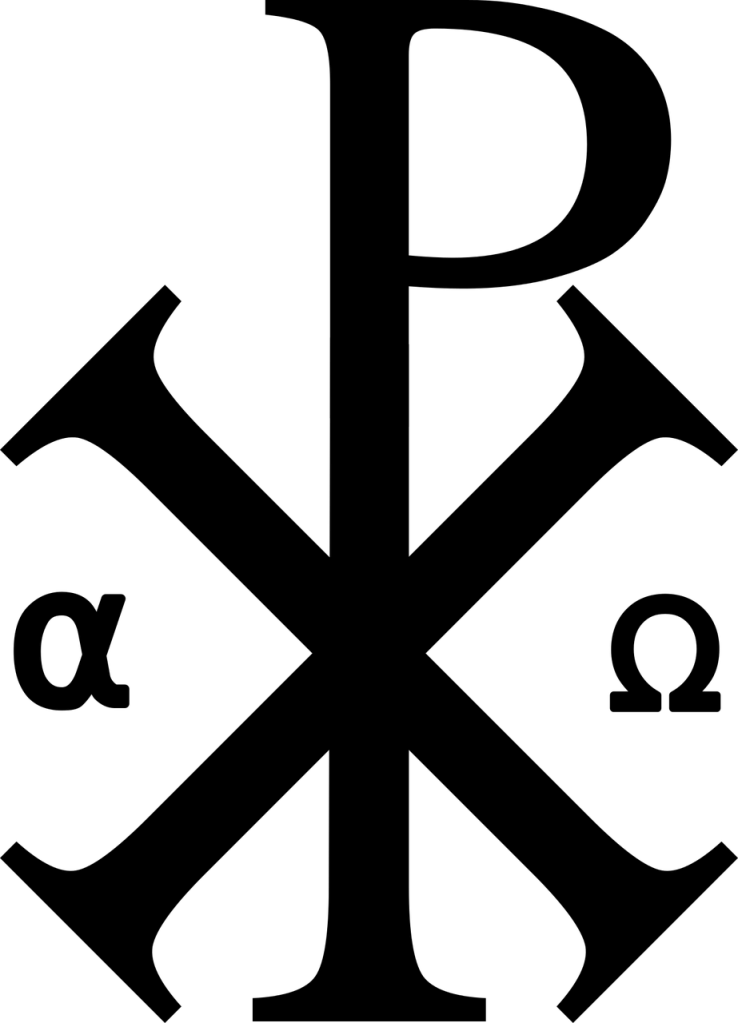
Chi-Rho Monogram
The two letters are from the Greek alphabet, even though they appear to be X and P in the English alphabet. Christ is frequently represented by the letters X and P. Christ’s name begins with the Greek letters X and P. X is equivalent to ‘CH’ (pronounced ‘Kye’) and P is equivalent to ‘R’ (pronounced ‘Roe’) in the Greek alphabet. The Chi-Rho Monogram was established.
The Chi-Rho Monogram is referred to as a Christogram. A Christogram is a symbol or combination of letters that forms an abbreviation for the name of Jesus Christ. It is used as a religious sign representing Christ, Christianity and Christians.
The letters XP symbolise Christ. “α” represents alpha, the first letter of the Greek alphabet, while “Ω” signifies omega, the last letter. In the Book of Revelation, Jesus is called the Alpha and the Omega (Revelation 1:8, 21:6, and 22:13). This illustrates that Jesus is both the beginning and the end of everything. Emphasising His eternal nature, which includes His presence at the creation of the world and His role at the end of times, reinforces the belief in His divinity and authority.
Y
Yeshua
The Hebrew name for Jesus, which means ‘the Lord saves,’ and it’s the name people called Him when He lived on Earth.
Z
Zechariah
Old Testament Book.
Zephaniah
Old Testament Book.

