International Saints

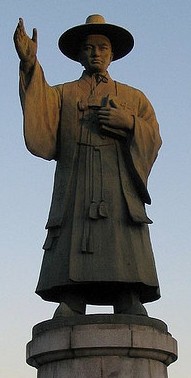
Statue of Saint Andrew Kim Taegon, the first Korean Catholic priest

St. Andrew Kim Taegon
Joseon Dynasty (Korea)

The first Korean Catholic priest and patron saint of Korean clergy. Born into the Yangban class, Kim’s parents were converts, and his father, uncles, and grandfathers were later martyred for practising Christianity, which was illegal in the highly Confucian society of Korea. After receiving baptism at 15, Kim pursued his studies at a seminary in the Portuguese colony of Macau.

He was ordained in China and went back to Korea to spread the gospel during the Joseon era, a time when Catholicism faced significant repression, leading many followers, including Andrew Kim, to endure persecution. He was eventually arrested, tortured, and beheaded near Seoul, the capital city of present-day South Korea.

Born: 1821
Died: 1846 (aged 25)
Feast Day: 20th of September
Canonised: 1984 by Pope John Paul II

An early work by Raphael (1503), at the Dulwich Picture Gallery, London, England, United Kingdom

St. Anthony of Padua

Portugal

Noted by his contemporaries for his powerful preaching, expert knowledge of scripture, and undying love and devotion to the poor and the sick, he was one of the most quickly canonised saints in church history, being canonised less than a year after his death.

Born: 1195
Died: 1231 (aged 35)
Feast Day: 13th of June
Canonised: 1232 by Pope Gregory IX

Saint Augustin by Philippe de Champaigne (1645)

St. Augustine of Hippo

 Numidia, Roman Empire (Algeria)

Augustine was a philosopher and theologian of Berber descent who served as the bishop of Hippo Regius in Numidia, located in Roman North Africa. His writings played a significant role in shaping Western philosophy and Christianity, and he is regarded as one of the most influential Church Fathers of the Latin Church during the Patristic Period. Among his many notable works are The City of God, On Christian Doctrine, and Confessions.

Numidia was an ancient realm that encompassed the area of modern-day Algeria, but it later grew to include parts of what we now call Tunisia and Libya.

Born: 354
Died: 430 (aged 75)
Feast Day: 28th of August
Canonised: Pre-Congregation

Bernadette in 1866, after having taken the religious habit and joining the Sisters of Charity

St. Bernadette of Lourdes

France

Renowned for witnessing apparitions of the Immaculate Conception (The Virgin Mary), who requested the construction of a chapel at a nearby cave grotto, these sightings occurred between the 11th of February and the 16th of July 1858. Following a canonical investigation, Soubirous’s accounts were deemed legitimate on the 18th of February 1862, and the Marian apparition became recognised as Our Lady of Lourdes.

The cave where the apparitions were reported later emerged as a significant pilgrimage destination and Marian shrine known as the Sanctuary of Our Lady of Lourdes, drawing approximately five million pilgrims from various denominations yearly.

Born: 1844
Died: 1879 (aged 35)
Feast Day: 16th of April
Canonised: 1933 by Pope Pius XI

Birth name Maria Francesca Cabrini.

St. Mother Cabrini

Lombardy-Venetia, Austrian Empire (Italy)

Frances Xavier Cabrini, commonly referred to as Mother Cabrini, was born in Lombardy-Venetia during the time of the Austrian Empire and was the first U.S. citizen to be canonised as a saint by the Catholic Church. She arrived in the United States from what is now Italy, making her entry into New York City, and subsequently founded the Missionary Sisters of the Sacred Heart of Jesus. Throughout her life, she established schools, orphanages, and hospitals across the U.S. and South America. She is recognised as the patron saint of immigrants.

Born: 1850
Died: 1917 (aged 67)
Feast Day: 13th of November (USA, 1961 to date). 22nd of December (elsewhere)
Canonised: 1946 by Pope Pius XII

Stained glass of St. Kizito being baptised by St. Charles Lwanga at Munyonyo Martyrs Shrine, Uganda.

St. Charles Lwanga and St. Kizito

Uganda

Saint Charles Lwanga and Saint Kizito are two of the most revered martyrs in Uganda. Both were young Christian converts in the court of King Mwanga II of Buganda. Charles Lwanga, the older of the two, was a catechist and leader who guided other Christian pages in the royal service. When King Mwanga demanded that they renounce their Christian faith, Charles and his companions refused.

Among them was Saint Kizito, a 13-year-old boy who, despite his youth, remained firm in his faith. Both were arrested, tortured, and executed by burning or beheading for refusing to abandon Christianity. Their courage in the face of persecution made them icons of faith, are commemorated as martyrs and patrons of Uganda and young Christian witnesses.

St. Charles Lwanga
Born: 1860
Died: 1886 (aged 26)
Feast Day: 3rd of June
Canonised: 1964 by Pope Paul VI

St. Kizito
Born: 1872
Died: 1886 (aged 13–14)
Feast Day: 3rd of June
Canonised: 1964 by Pope Paul VI

White Marble head of Constantine, Capitoline Museums, Italy (312–315 AD)

St. Constantine the Great

Moesia, Roman Empire (Serbia)

An emperor from 306 to 337 AD, Constantine was the first Roman emperor to convert to Christianity. He played a pivotal role in elevating the status of Christianity in Rome, decriminalising Christian practice and ceasing Christian persecution in a period referred to as the Constantinian shift. This initiated the Christianisation of the Roman Empire. He founded the city of Constantinople and made it the capital of the Empire, which remained so for over a millennium.

Constantine was born in the city of Naissus from the Roman province of Moesia, an area in the Balkans that encompasses parts of modern-day Serbia, Bulgaria, and Romania.

Born: 272
Died: 337 (aged 65)
Feast Day: 21st of May
Canonised: Pre-Congregation

Portrait painted by Amabilia Filicchi

Saint Elizabeth Ann Seton

Province of New York, British America (United States of America)

A Catholic religious sister in the United States and an educator recognised as a pioneer of the nationwide parochial school system. Originating from New York and raised in the Episcopal faith, she married her spouse, William Seton, and they had five children together. Two years following his passing, she converted to Catholicism in 1805.

Seton launched the first Catholic school for girls in the country, Emmitsburg, Maryland. Additionally, she established the first American congregation of religious sisters, known as the Sisters of Charity. After her passing, Seton became the first individual born in what would later be the United States of America to be canonised by the Catholic Church.

Born: 1774
Died: 1821 (aged 46)
Feast Day: 4th of January
Canonised: 1975, by Pope Paul VI

Saint Francis of Assisi in Ecstasy by Jusepe de Ribera, (1639)

St. Francis of Assisi

Italy

In 1219, he travelled to Egypt to try to convert Sultan al-Kamil and bring an end to the conflict associated with the Fifth Crusade. In 1223, he organised the first live nativity scene as part of the Christmas celebrations in Greccio. According to Christian tradition, in 1224, Francis experienced the stigmata during a vision of a Seraphic angel.

Francis is the patron saint of animals and the environment. It became a tradition for churches to hold blessings for animals on his feast day of October 4th, now recognised as World Animal Day. He was known for his deep devotion to the Eucharist. He was declared the patron saint of Italy and is also the namesake of San Francisco, a city in America.

Born: 1181
Died: 1226 (aged approx. 44)
Feast Day: 4th of October
Canonised: 1228 by Pope Gregory IX

Painting of Saint Francis Xavier, held in the Kobe City Museum, Japan (1623)

St. Francis Xavier

Spain

Recognised as one of the most significant missionaries of the Catholic Church and a co-founder of the Jesuit order, Francis Xavier spread Christianity throughout Asia, particularly in India, Japan, and the Maluku Islands. His missionary work is noted for its emphasis on adapting to local cultures and languages.

St. Francis Xavier is also celebrated for his unwavering commitment to his faith, compassion for the indigenous peoples he encountered, and dedication to education. He was canonised by the Catholic Church in 1622 and is the patron saint of missionaries.

Born: 1506
Died: 1552 (aged 46)
Feast Day: 3rd of December
Canonised: 1622 by Pope Gregory XV

Saint George Killing the Dragon by Bernat Martorell (1434/35)

St. George

Cappadocia, Roman Empire (Turkey)

St. George was a soldier in the Roman army. He was of Cappadocian (present-day Turkey) and Greek origin. He became a member of the Praetorian Guard for Roman emperor Diocletian, but he was sentenced to death for refusing to recant his Christian faith. Saint George became one of the most venerated saints and heroes in Christianity. He has been especially venerated as a military saint since the time of the Crusades.

Born: 3rd century
Died: 303
Feast Day: 23rd of April
Canonised: Pre-Congregation

Ignatius in his armour, in a 16th-century painting

St. Ignatius of Loyola

Spain

A former soldier, Ignatius experienced a profound transformation after the fierce Battle of Pamplona on the 20th of May 1521. During this tumultuous conflict, he sustained severe injuries from a cannonball, which shattered his right leg and altered the course of his life. Following his recovery, he dedicated himself to religious pursuits, eventually becoming a priest and a respected theologian.

In 1534, he took a monumental step by founding the Jesuit order, which would go on to play a pivotal role in the Counter-Reformation, making him one of the most influential figures of that era.

Born: 1491
Died: 1556 (aged 64)
Feast Day: 31st of July
Canonised: 1622 by Pope Gregory XV

Historiated initial depicting Joan of Arc

St. Joan of Arc

France

Joan of Arc was a young peasant girl from France, born around 1412. She asserted that she experienced visions and heard voices from saints directing her to support Charles VII and lead France to victory during the Hundred Years’ War against England. In 1429, she played an essential role in lifting the siege of Orléans, significantly uplifting French morale.

Later, she assisted in the coronation of Charles VII at Reims. However, in 1430, she was captured by the Burgundians, who were allies of the English, and sold to them. Joan was tried for heresy and witchcraft, found guilty, and executed by burning at the stake in 1431 at the age of 19.

Joan of Arc is the patron saint of France, soldiers, and prisoners.

Born: 1412
Died: 1431 (aged approx. 19)
Feast Day: 30th of May
Canonised: 1920 by Pope Benedict XV

Pope John Paul II (1991)

St. John Paul II

Poland

The first non-Italian pope in 455 years, he travelled extensively abroad to promote greater understanding between countries and religions. He campaigned against political oppression, violence, and materialism. He is credited with helping to end communist rule in his native Poland and the rest of Europe and survived an assassination attempt in 1981.

Born: 1920
Died: 2005 (aged 84)
Feast Day: 22nd of October
Canonised: 2014 by Pope Francis

Portrait of Josephine Bakhita

St. Josephine Bakhita

Sultanate of Darfur (Sudan)

Born in the pre-colonial state of the Sultanate of Darfur (present-day Sudan), Josephine was captured and sold into slavery at 7–8 years of age. ‘Bakhita’ was not the name she received from her parents at birth. It is said that the trauma of her abduction caused her to forget her original name; she took one given to her by the slavers.

She was eventually freed and brought to Italy, where she found refuge in a convent, converted to Christianity and became a nun with the Canossian Daughters of Charity in Italy.

She is remembered for her deep faith and remarkable story of suffering, forgiveness, and joy. Saint Josephine Bakhita is the patron saint of Sudan and victims of human trafficking.

Born: 1869
Died: 1947 (aged 77–78)
Feast Day: 8th of February
Canonised: 2000 by Pope John Paul II

Saint Juan Diego by Miguel Cabrera (1752)

St. Juan Diego

Tenochtitlan, Aztec Empire (Mexico)

Juan Diego, an indigenous man from the Aztec Empire in present-day Mexico, is renowned for his encounters with the Virgin Mary in 1531 near Mexico City on Tepeyac Hill. She asked him to tell the bishop to build a church in her honour. Initially met with scepticism, the bishop was convinced when Juan Diego presented roses blooming in December and revealed a miraculous image of Our Lady of Guadalupe imprinted on his tilma. This event significantly advanced the spread of Catholicism in the region.

Born: 1474
Died: 1548 (aged 73–74)
Feast Day: 9th of December
Canonised: 2002 Pope John Paul II

Saint Augustine and his mother, Saint Monica, by Ary Scheffer (1846)

St. Monica

 Numidia, Roman Empire (Algeria)

Monica was the mother of St. Augustine of Hippo. She is venerated in the Catholic Church for her remarkable Christian virtues, particularly the pain stemming from her husband’s infidelity, along with her devoted prayer life dedicated to the reformation and conversion of her then-troubled son, who extensively documented her virtuous deeds and their life together in his work, Confessions.

She is frequently called upon as the patron saint of mothers, wives and people suffering under difficult circumstances.

Born: 332
Died: 387 (aged 55)
Feast Day: 4th of May
Canonised: Pre-Congregation

Full-length icon by Jaroslav Čermák, showing Saint Nicholas with a halo, dressed in clerical garb, and holding a book of the scriptures in his left hand while making the hand gesture for the sign of the cross with his right

St. Nicholas of Myra/Bari

Lycia et Pamphylia, Roman Empire (Turkey)

Nicholas was an early Christian bishop of Greek descent from the maritime city of Patara in Anatolia (in modern-day Antalya Province, Turkey) during the time of the Roman Empire. Because of the many miracles attributed to his intercession, he is also known as Nicholas the Wonderworker. Saint Nicholas is the patron saint of sailors, merchants, archers, repentant thieves, children, brewers, pawnbrokers, toymakers, unmarried people, and students in various cities and countries around Europe. 

His reputation evolved among the pious, as was common for early Christian saints, and his legendary habit of secret gift-giving gave rise to the folklore of Santa Claus (“Saint Nick”) through Sinterklaas.

Born: 270
Died: 343 (aged 73)
Feast Day: 6th of December
Canonised: Pre-Congregation

Statue of Miki, bearing stylised depictions of the instruments of his death, in St Martin’s Church in Bamberg, Germany.

St. Paul Maki

Japan

Paul Maki was a Jesuit priest from Japan and a martyr, recognised for his lineage as the son of a samurai and his contributions to the spread of Christianity in Japan. He was among the twenty-six Christians who faced crucifixion in Nagasaki during a government crackdown on Christianity in Japan.

Born: 1562
Died: 1597 (aged 34-35)
Feast Day: 6th of February
Canonised: 1862 by Pope Pius IX

Official portrait photograph of Padre Pio (1947)

St. Padre Pio

Italy

Padre Pio is recognised as the Patron Saint of Civil Defence Volunteers because he served in the military as a Friar in World War I.

Known for his deep spirituality, he exhibited profound compassion and a strong commitment to the sacramental life. He is best known for experiencing the stigmata, the physical wounds resembling those of Christ, which he bore for much of his life. This phenomenon attracted many pilgrims and seekers of spiritual guidance to him.

Born: 1887
Died: 1968 (aged 81)
Feast Day: 23rd of September
Canonised: 2002 by Pope John Paul II

Saint Rose of Lima by Claudio Coello, in the Prado Museum, Madrid, Spain (1642–1693)

St. Rose of Lima

Peru

Born Isabel Flores de Oliva in Lima, Peru, Rose was the first person in South America to be canonised by the Catholic Church. From a young age, Rose dedicated her life to God, choosing a life of prayer, penance, and service to the poor rather than marriage. She joined the Third Order of Saint Dominic and lived in a small cell in her family’s home, where she spent much of her time in prayer and worked tirelessly to care for the sick and the poor. She is the patron saint of Peru, South America, and the continent’s indigenous peoples.

Born: 1586
Died: 1617 (aged 31)
Feast Day: 23rd of August
Canonised: 1671 by Pope Clement X

Mother Teresa of Calcutta (1986)

St. Mother Teresa of Calcutta

Kosovo, Ottoman Empire (North Macedonia)

Teresa was born in North Macedonia and moved to Ireland at 18 to join the Sisters of Loreto. She later relocated to India, where she spent most of her life.

She became known for her extraordinary humanitarian work, dedicating her life to serving the poor and sick, particularly in the slums of Kolkata (Calcutta), India. As the founder of the Missionaries of Charity, she established homes for the dying, orphanages, and schools. Her compassion and selfless service earned her global recognition, culminating in the Nobel Peace Prize she received in 1979.

Mother Teresa is also remembered for her teachings on love, kindness, and the dignity of every human being. In 2016, she was canonised as a saint by the Catholic Church.

Mother Teresa was born in the city of Skopje, which was part of the Ottoman Empire, that controlled much of Southeast Europe until it collapsed after World War I. The region where Mother Teresa was born eventually became part of Yugoslavia before gaining independence as North Macedonia in 1991.

Born: 1910
Died: 1997 (aged 87)
Feast Day: 5th of September
Canonised: 2016 by Pope Francis

Panel of an altarpiece from Ascoli Piceno, Italy, by Carlo Crivelli (15th century)

St. Thomas Aquinas

Italy

Considered the greatest of the Scholastic philosophers. He produced a comprehensive synthesis of Christian theology and Aristotelian philosophy that influenced Roman Catholic doctrine for centuries and was adopted as the official philosophy of the church in 1917.

Born: 1225
Died: 1274 (aged 48–49)
Feast Day: 28th of January
Canonised: 323 by Pope John XXII

BBC Hulton Picture Library

St. Therese of Lisieux

France

Thérèse of Lisieux, also known as “The Little Flower,” is best known for her deep spiritual insights and simple, childlike approach to faith. She emphasised the importance of love and trust in God, and her teachings revolve around the “little way,” which encourages people to embrace humility and perform small acts of kindness. Thérèse’s autobiography, “Story of a Soul,” has inspired many and has made her one of the most beloved saints in the Catholic Church.

She is also recognised as a Doctor of the Church, a title the Catholic Church gives to saints whose writings and teachings have significantly contributed to Church doctrine and theology.

Born: 1873
Died: 1897 (aged 24)
Feast Day: 1st of October
Canonised: 1925 by Pope Pius XI

Oil painting of St. Ulrich of Augsburg by Leonhard Beck (1510)

St. Ulrich of Augsburg

Augsburg, Holy Roman Empire (Switzerland)

Ulrich of Augsburg was a bishop and one of the most significant saints of mediaeval Germany. Born into a noble family, he became the Bishop of Augsburg and was known for his dedication to the spiritual and social welfare of his people. Ulrich worked tirelessly to promote Christian values, reform the clergy, and care for the poor and sick. He was also known for his strong leadership in the face of political and military challenges, particularly during the Hungarian invasions in the 10th century.

He is considered the patron saint of Augsburg and of the Diocese of Augsburg. His life exemplifies devotion to both faith and community, and his legacy continues to inspire many in the Catholic Church.

Born: 890
Died: 973 (aged 82 or 83)
Feast Day: 4th of July
Canonised: 993 by Pope John XV

St. Valentine healing a man with epilepsy

St. Valentine

Italy

St. Valentine is primarily known as the patron saint of lovers, beekeepers, and epileptics. His feast day, celebrated on February 14, is associated with romantic love, mainly due to stories and legends surrounding his life and martyrdom.

One famous tale suggests that he secretly married couples in love when Roman Emperor Claudius II banned marriages for young men, believing single men made better soldiers. Over time, St. Valentine became a symbol of love and affection, leading to the modern celebration of Valentine’s Day.

Born: 226
Died: 269 (aged 42–43)
Feast Day: 14th of February
Canonised: Pre-Congregation

Seventeenth-century portrait of Vincent by Simon François de Tours

St. Vincent de Paul

France

Saint Vincent de Paul was a 17th-century French priest renowned for his commitment to serving the poor. He founded the Congregation of the Mission and co-founded the Daughters of Charity, focusing on providing help to those in need and improving their living conditions.

The St. Vincent de Paul Society (SVP) is named after him and was established in 1833 as a charitable organisation dedicated to helping those in need. SVP is a well-known organisation in Ireland as it plays a significant role in providing support to disadvantaged individuals and families through various initiatives, including home visits, food donations, and financial assistance.

Born: 1581
Died: 1660 (aged 79)
Feast Day: 27th of September
Canonised: 1737 by Pope Clement XII