“We have a Lord who is capable of crying with us, capable of walking with us in the most difficult of times.”
Pope Francis
In the face of death, grief and loss, the church provides a proclamation of hope. At the time of a funeral through prayer and ritual, we take part in a two-fold journey. We celebrate the life of the one who has died and journey with the body of the deceased, honouring the body and soul commending them to God’s merciful love. We journey also with all those who mourn, praying for consolation, healing and comfort.
In the first section of this page of our website we outline the way that funerals take place in Ashbourne parish. In the second section of this page, we explain how burials happen and in the final section we outline the dates of annual cemetery devotions. Parishioners should be aware our priests are available to discuss any aspect of the various funeral liturgies and to help and assist anyone organising the celebration of the Eucharist or prayers for a deceased loved one.
Part 1 Organising a Church Funeral
Reception of the Remains
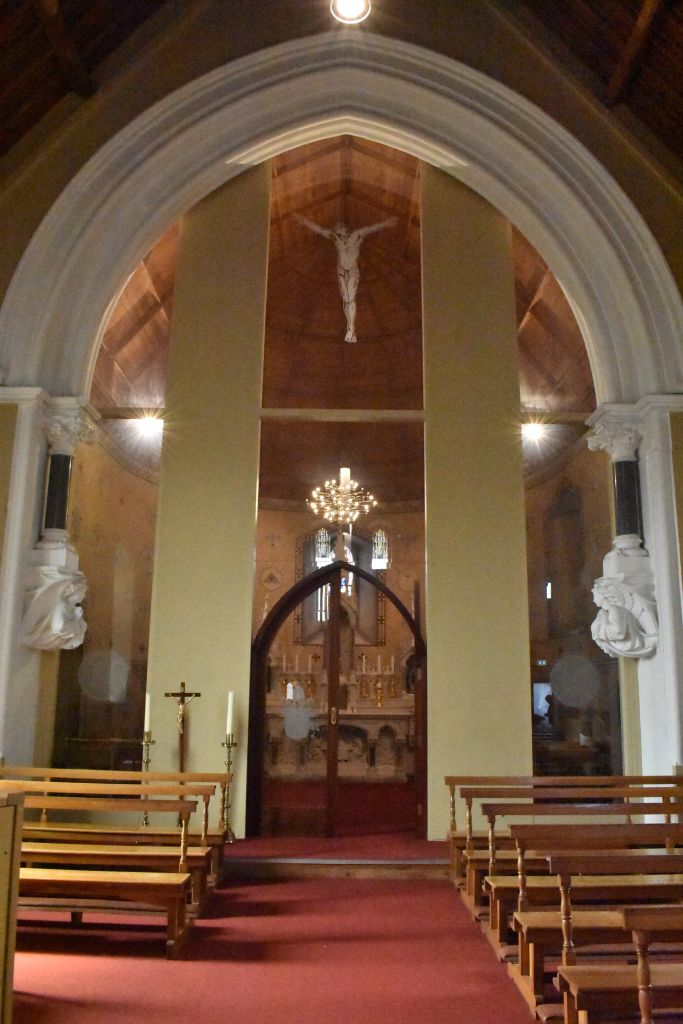
The remains of the deceased are either received into Ashbourne or Donaghmore Church the night before the Funeral Mass or just prior to the Mass itself. The immediate next of kin walk behind the coffin as it is brought into the parish church. The congregation stand as the deceased is brought before the altar, and the family take their seats at the front of the church on the righthand side of the main aisle. If the remains are brought in the evening before there is a short, simple ceremony called the Rite of Reception which is led by a priest of the parish. The reception of the remains normally takes place at 5.30pm. The priest reads a Gospel of his choosing and leads the community in prayer before people approach the family with their sympathies.
Funeral Mass
The principal celebration of the Christian funeral in the Catholic tradition is the Mass, the memorial of the death and resurrection of Christ. Funeral Masses can take place in Ashbourne or Donaghmore Churches on any day of the week except a Sunday. The usual time for a funeral Mass is 11am but sometimes for pastoral reasons the Mass takes place at a later time.
Symbols
Sometimes family members wish to include in the Mass some symbols or mementoes of their loved one. Just after Mass has begun the symbols are brought in procession by family members or friends and placed on the Symbol Table adjacent to the coffin. Usually, four or five symbols are sufficient. One of the symbols should be a spiritual gift to represent the faith of the deceased. The priest speaks about each symbol as they are brought forward.
Readings
After the Opening Prayer we allow the Word of God to speak to us. In the Liturgy of the Word at our funeral liturgies, texts of readings, prayers and hymns comfort us with the reminder that God is with us at every stage in our journey of life and especially in death, when ‘life is changed, not ended’ (Preface of Christian Death I).
Readings provide another opportunity for people to become involved in the funeral liturgies. There are two readings at a funeral Mass. The family choose the readings from the funeral booklet given to them by the priest or provided on the link here. The First Reading is from the Old Testament. The Responsorial Psalm is sung but if this is not possible, it is read. The Second Reading is from the New Testament. Both readers should approach the altar together and bow. The first reader goes to the ambo to proclaim the word while the second reader is seated next the ambo. After the readers are finished, they go back to their seats without any need to bow as they return to their seat. When you are choosing readers think about asking people who are used to reading in public and who will be well prepared and self-composed. If the task of reading will cause them undue anxiety because of nervousness or grief, it is advisable to involve them in some other way.
Everyone stands as the Gospel Acclamation is sung. The good news of Jesus Christ is then proclaimed in the reading of the gospel. In the homily after the gospel proclamation the priest’s role is to convey belief and hope in eternal life. The priest links the life of the deceased with the building of the kingdom of heaven here on earth. Please be aware that the homily is not a eulogy or a talk about the deceased. The homily links the life of the deceased with the gospel and reflection on our belief in Christ’s death and resurrection.
Prayer of the Faithful
After the Gospel and homily there is what is called the ‘Prayer of the Faithful’. Family members are again welcome to lead the congregation in the Prayer of the Faithful. Five or six prayers are offered for the deceased, for the family and all who mourn, and for the intentions of the congregation. Those going up to the ambo should bow together and wait at the ambo until the Prayer of the Faithful is concluded by the priest.
Eulogies are not part of our Funeral Masses
Ashbourne Parish is part of the Diocese of Meath. Eulogies do not take place at our Funeral Masses. This has always been the diocesan policy across the sixty-nine parishes of the diocese. Families should not seek an exception for their loved one as we seek to treat everyone the same and allow the liturgy for the deceased to speak for itself. If family or friends feel the need to speak, they do so at the Rite of Committal, at the cemetery or crematorium, and some make speeches at the gathering which many families have when the funeral liturgy is concluded.
Offertory Gifts
At the start of the Liturgy of the Eucharist the offertory gifts of Bread and Wine are brought forth to be consecrated in the Mass. Together two family members or friends of the deceased take the gifts from the Offertory table to the priest offering the Mass. After the gifts are handed over the bearers bow towards the priest and altar as a sign of reverence. The priest bows in return as an expression of thanks.
Holy Communion
Family members are encouraged to pray the Mass and to enter fully into the mystery of salvation being expressed in the reliving of Jesus’ last Supper. During the Consecration all in the church kneel and the congregation stand for the praying of the Lord’s prayer. At communion time the faithful receive Holy Communion. When coming forward for Holy Communion in our churches the congregation use the main aisle and go back to their seats by the side aisles. Coeliac hosts are available at Communion time and a person wishing to receive a coeliac host should simply let the priest or Eucharistic Minister know that they wish to have this host. A Blessing is also available for those who would like this option instead of Holy Communion. A person should simply cross their hands in front of them to indicate their desire.
Rite of Commendation and Sympathising
After communion and the Final Prayer of Mass everyone stands for the Rite of Commendation which begins with the springling of the remains with holy water and the incensation of the coffin. After the Prayer of Final Commendation sympathising can take place in our churches. As the mortal remains are brought down the church aisle the congregation stands, and the Recessional Hymn is sung.
Month’s Mind Masses and 1st Anniversary Masses
In the catholic tradition a Mass is offered for the deceased about a month after their funeral and on the anniversary of their death in subsequent years. If desired, one of the next of kin should contact the Parish Office to arrange these Masses. In Ashbourne Parish the Month’s Mind or First Anniversary Masses are reserved for Sunday Masses at 11am and 12.30pm. Family members are invited to bring up the offertory gifts at these Masses.
Annual Bereavement Remembrance Mass
At the end of November each year Ashbourne Parish organises a Mass for all those whose funerals have taken place in our parish churches over the last twelve months. A member of each family is invited to place a lit candle for their loved one on Ashbourne Church altar as we pray for them and all the deceased during this annual Remembrance Mass.
Part 2 The Rites of Committal
Ashbourne Cemetery
A
Rite of Committal of the Coffin in a Cemetery
Six cemeteries in Ashbourne provide a final resting place for the faithful departed. These cemeteries strive to be a dignified place for family, friends and parishioners to visit, reflect and pray. It is important as the years go by that the cemeteries are kept well maintained. Families are asked to maintain their graves and to do their best to keep their plots tidy at all times. Rubbish should be brought home for disposal and wreaths; weeds and flowerpots should be disposed of in a responsible way when their life cycle is over.
Ashbourne Church Cemetery and Donaghmore Church Cemetery are both owned and managed by the parish. The other cemeteries in Ashbourne fall outside of the parish remit. St. Declan’s is owned and managed by Meath County Council. Old Donaghmore, Greenouge and Killegland Cemeteries are looked after by local volunteers working in conjunction with the local authority.
Both parish cemeteries at Donaghmore and Ashbourne Churches are full, and committals take place in existing graves only. Access to the two parish cemeteries for workers digging a grave or working on a headstone is gained through contact with the Parish Office or one of the priests of the parish. The parish staff also ensure that evidence of insurance has been obtained for those entering the cemeteries to carry out works.
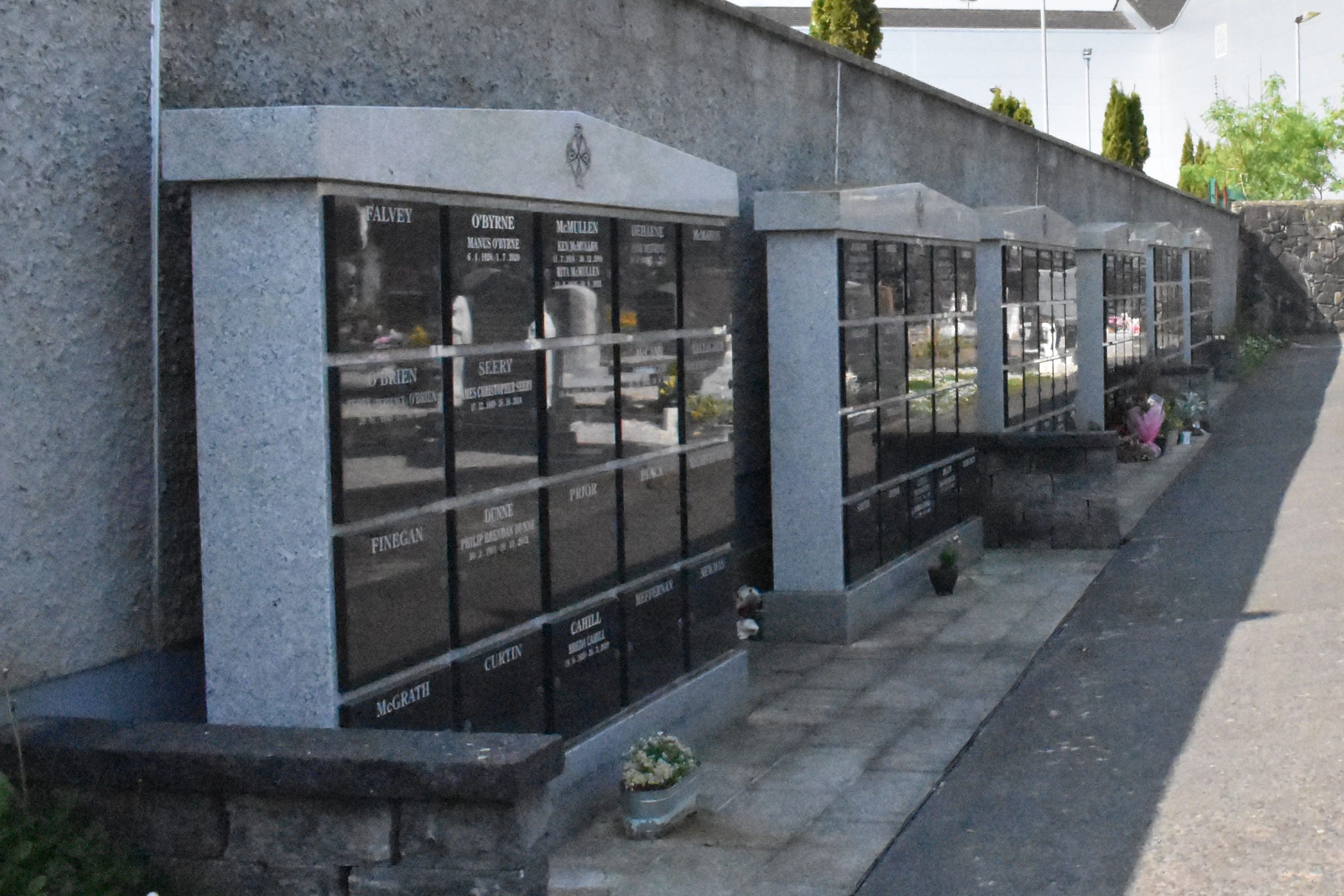
Columbarium wall in Ashbourne Cemetery
B
Rite of Committal of the Urn of Ashes in the Parish Columbarium
The Catechism of the Catholic Church states that “Cremation is allowed by the Catholic Church provided that it does not demonstrate a denial of faith in the resurrection of the body” (CCC, no. 2301). The catechism asks that as soon as possible after the funeral liturgy the cremated remains are to be buried in a grave or placed in a columbarium. The cremated remains at all times should be treated with the same respect given to the human body from which they came.
In 2016 Ashbourne Parish installed a Columbarium in Ashbourne Church grounds with niche spaces for the inurnment and memorialisation of cremated remains. Families can find out about this option by clicking the link below or by contacting Ashbourne Parish Office and asking for a copy of the Parish Columbarium Policy. A niche is purchased in the Parish Columbarium after completion of the Columbarium Application Form and by approval of the parish priest or his designate. Once the terms are signed and the Application Form complete a niche is allocated to the next of kin.
Niches are not pre-sold to individuals or families and are allocated in an orderly manner as needs arise. Once a family has received notice from their funeral director that the ashes of their loved one are ready for collection from the Crematorium a ceremony of committal of the ashes should be arranged through the Parish Office. The urn with the ashes is present at one of the daily or Sunday Masses in Ashbourne Church and after the Mass the Rite of Committal led by a priest of the parish takes place at the allocated Columbarium niche.